
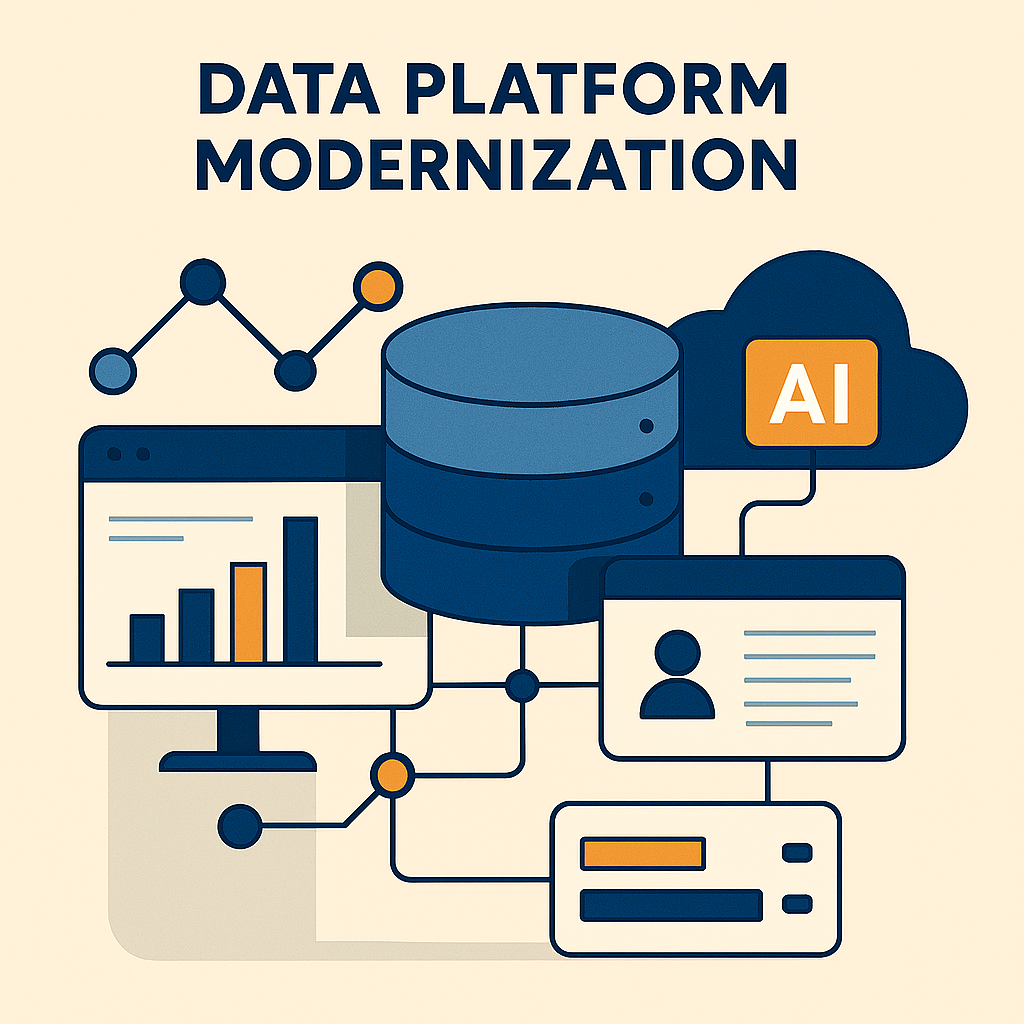
Data warehouse modernization has become a strategic imperative for enterprises seeking to accelerate analytics, reduce operational costs, and enable AI‑driven decision‑making. Legacy data warehouses—often constrained by aging architectures, rigid ETL processes, and escalating maintenance costs—can no longer support the speed, scale, and complexity of modern data demands.
This guide provides a comprehensive, executive‑level overview of modernization drivers, architectural considerations, cloud platform options, governance requirements, migration patterns, and the organizational capabilities required to execute modernization successfully. It is designed for CIOs, CTOs, CDOs, and enterprise data leaders responsible for shaping the next generation of their organization’s data ecosystem.
1. The Strategic Context for Modernization
Modern enterprises operate in an environment defined by real‑time expectations, AI‑driven insights, and rapidly evolving cloud capabilities. Traditional data warehouses—built for batch processing, structured data, and predictable workloads—struggle to meet these demands.
Key pressures driving modernization include:
- AI and machine learning adoption
- Real‑time analytics and event‑driven architectures
- Explosive data growth across cloud and SaaS systems
- Rising costs of legacy infrastructure
- Increasing regulatory and governance requirements
- Demand for self‑service BI and semantic consistency
Executives increasingly recognize that modernization is not a technical upgrade—it is a foundational enabler of digital transformation.
2. What Data Warehouse Modernization Really Means
Modernization is often misunderstood as a simple migration to the cloud. In reality, it is a comprehensive transformation that includes:
2.1 Architectural Evolution
From monolithic, on‑premises systems to distributed, cloud‑native platforms optimized for elasticity, performance, and cost efficiency.
2.2 Data Processing Transformation
Shifting from ETL‑centric pipelines to ELT patterns that leverage cloud compute.
2.3 Governance and Quality Reinforcement
Implementing modern governance frameworks, lineage, and metadata management.
2.4 BI and Semantic Layer Modernization
Supporting Power BI, Tableau, Qlik, Spotfire, and MicroStrategy with scalable models.
2.5 Operational Excellence
Automating monitoring, cost controls, and performance optimization.
Modernization is a strategic shift toward a more agile, scalable, and AI‑ready data ecosystem.
3. Common Challenges of Legacy Data Warehouses
Executives often encounter the same systemic issues:
3.1 Performance Bottlenecks
Slow queries, overloaded compute, and rigid indexing strategies.
3.2 High Operational Costs
Legacy hardware, licensing, and maintenance overhead.
3.3 Fragile ETL Pipelines
Complex, brittle workflows that break under scale.
3.4 Limited Scalability
Inability to handle new data sources, formats, or volumes.
3.5 BI Limitations
Semantic inconsistencies, slow refresh cycles, and user frustration.
3.6 Governance Gaps
Lack of lineage, quality controls, and auditability.
These challenges compound over time, creating operational risk and strategic drag.
4. Modern Cloud Platforms: Azure, Snowflake, and Databricks
Executives typically evaluate three leading platforms:
4.1 Microsoft Azure (Azure Synapse Analytics & Microsoft Fabric)
Strengths:
- Deep integration with Microsoft ecosystem
- Strong governance and security
- Unified analytics capabilities
Best for:
- Enterprises heavily invested in Microsoft
- Organizations prioritizing integrated BI and data engineering
4.2 Snowflake
Strengths:
- Exceptional simplicity and elasticity
- Separation of storage and compute
- Strong multi‑cloud capabilities
Best for:
- Organizations seeking ease of use and predictable performance
- Multi‑cloud strategies
4.3 Databricks
Strengths:
- Industry‑leading AI/ML capabilities
- Lakehouse architecture
- High‑performance processing
Best for:
- AI‑driven organizations
- Complex data engineering and unstructured data workloads
5. The Modernization Roadmap
A successful modernization program follows a structured, phased approach.
5.1 Assessment
- Current‑state architecture
- Data quality and governance
- ETL/ELT pipelines
- BI usage and performance
- Cost analysis
Deliverable: Modernization Readiness Assessment
5.2 Architecture Design
- Target platform selection
- Data model modernization
- Ingestion and transformation patterns
- Security and governance frameworks
Deliverable: Target State Architecture Blueprint
5.3 Migration Planning
- Workload prioritization
- Data movement strategy
- BI migration sequencing
- Risk mitigation
Deliverable: Migration Plan & Timeline
5.4 Implementation
- Pipeline rebuilds
- Data validation
- BI model modernization
- Performance optimization
Deliverable: Modernized Data Warehouse
5.5 Governance & Optimization
- Cost controls
- Monitoring
- Quality frameworks
- Ongoing enhancements
Deliverable: Operational Excellence Framework
6. Migration Patterns
Executives typically choose from three patterns:
6.1 Lift‑and‑Shift
Fastest, but least transformative.
6.2 Hybrid Modernization
Parallel runs with phased migration.
6.3 Full Re‑Engineering
Highest long‑term value; rebuilds pipelines and models.
7. Governance Requirements
Modern governance includes:
- Data lineage
- Metadata management
- Quality scoring
- Access controls
- Auditability
- Policy automation
Governance must be embedded—not bolted on.
8. Cost Optimization Considerations
Executives should evaluate:
- Compute auto‑scaling
- Storage tiering
- Pipeline efficiency
- BI query optimization
- Workload isolation
Cloud cost management is a continuous discipline.
9. AI & Real‑Time Analytics Enablement
Modern warehouses support:
- Real‑time ingestion
- Feature stores
- ML model integration
- Event‑driven architectures
AI readiness is a key modernization outcome.
10. Organizational Capabilities Required
Modernization requires:
- Data engineering maturity
- Governance leadership
- BI alignment
- Executive sponsorship
- Change management
Technology alone is insufficient.
11. How On Point BI Supports Modernization
On Point BI provides:
- Modernization assessments
- Architecture design
- Platform selection guidance
- Pipeline modernization
- BI model redesign
- Governance frameworks
- Executive‑ready roadmaps
Our approach is platform‑agnostic and outcome‑driven.
12. Conclusion
Data warehouse modernization is no longer optional—it is a strategic requirement for enterprises seeking agility, AI readiness, and competitive advantage. Organizations that modernize effectively unlock faster insights, lower costs, and a more resilient data foundation. Those that delay risk falling behind in an increasingly data‑driven economy.